

Published March 30, 2026

Your Top Formula Questions Answered
By Family Medicine Physician Dr. Max Goldstein, MD
Is there actually a “best” baby formula?
There isn’t a single formula that is best for every baby. All infant formulas sold in the United States meet strict nutritional standards, which means they provide the essential nutrients babies need to grow. Where formulas differ is in their ingredient sourcing and how they’re made.
For example, some formulas use organic ingredients while others use conventional. Some rely on whole milk as their primary fat source, while others use skim milk supplemented with vegetable oils. USDA Organic Certification means that the ingredients were produced without synthetic pesticides or GMOs. Whole milk formulas are also gaining attention because their fat composition more closely resembles the fat profile of breastmilk, which can reduce the need for added oils.
Ultimately, if your baby is thriving on a formula, there is no reason to keep searching. But when parents are making an initial choice, understanding these ingredient differences can help them select a formula they feel confident about.
What’s the difference between European and American formula?
Both European and American infant formulas are carefully regulated, but they are overseen by different regulatory bodies. In the United States, formulas are regulated by the FDA, while in Europe they are regulated by the European Food Safety Authority (EFSA). These agencies use slightly different standards around ingredients and additives.
European regulations tend to be stricter on certain sweeteners, but both systems are designed to ensure formulas are nutritionally complete and safe for infants. The real differences tend to come down to ingredient sourcing and formulation philosophy rather than safety.
What is a whole milk formula, and does it matter?
Whole milk formulas use whole milk as the primary fat source rather than skim milk combined with added vegetable oils. Because whole milk already contains natural milk fat, these formulas rely less on supplemental oils such as soybean or palm oil to meet fat requirements.
Milk fat also more closely resembles the fat composition naturally found in breastmilk. For some parents, this makes whole milk formulas appealing because they feel less processed and closer to the way milk naturally occurs.
It’s important to note that whole milk formulas are not specialty formulas. They still meet all nutritional requirements for infant feeding. For parents who are paying close attention to ingredient sourcing or the use of added oils, whole milk formulas, like Bobbie Organic Whole Milk Infant Formula, can be an option worth exploring.
Sign up to get the scoop on feeding, sleep, poop, and so much more. By singing up for email, you are to receive marketing emails from Bobbie and can manage your email preferences or unsubscribe at anytime

Your go-to resource for all things new baby.
Are there formulas without seed oils?
Fat is an essential part of infant nutrition because it supports brain development and provides a significant portion of a baby’s daily calories. Because of this, all formulas contain a blend of fats.
Many standard formulas use a combination of plant-based oils that may include soybean, palm, coconut, or sunflower oil to supplement skim milk. Formulas that use whole milk as their base can naturally reduce the amount of added oils needed, because milk fat is already present. Even so, all formulas contain added oils in order to mirror the fatty acid profile of breast milk. It’s not possible to find a formula without seed oils, as infants need a specific blend of omega-3 and omega-6 fatty acids for appropriate growth.
For parents concerned about seed oils, it can be helpful to look closely at the ingredient list and understand where the fat in the formula is coming from. The overall quality of ingredients and the formula’s ability to meet nutritional requirements are what matter most.
Does organic formula actually make a difference?
Organic certification in the United States is a regulated standard overseen by the USDA. When a formula is labeled organic, it means the ingredients were produced without synthetic pesticides, herbicides, antibiotics, or genetically modified organisms.
For infant formula, this certification applies to the dairy and other agricultural ingredients used in the product. Many parents choose organic options because they want to minimize potential pesticide exposure during infancy.
It’s important to distinguish between true certification and marketing language. Terms like “natural” or “clean” do not carry regulatory meaning, while USDA Organic certification does. At the same time, babies who are thriving on conventional formula are doing just fine. Organic certification simply gives parents additional information when comparing options.
Am I messing up by supplementing with formula?
Absolutely not. Combination feeding, which means using both breastmilk and formula, is extremely common and often necessary for many families.
There is no hierarchy that determines which feeding method makes someone a better parent. Some families breastfeed exclusively, some use formula exclusively, and many do some combination of both. What matters most is that the baby is fed, growing, and that the feeding approach works for the family.
If parents are supplementing with formula, choosing one with high-quality ingredients can help complement breastmilk feeding. Introducing formula gradually when possible and watching for comfort and growth can make the transition smoother.
My baby seems gassy. Should I switch formulas?
Gas and spit-up are extremely common during early infancy and do not always mean the formula is the problem. In many cases, feeding technique plays a larger role. Nipple flow rate, feeding pace, and whether a baby is swallowing excess air can all contribute to gassiness.
Before switching formulas, it’s worth looking at these factors first. Slowing down feeds or adjusting nipple flow can sometimes make a significant difference.
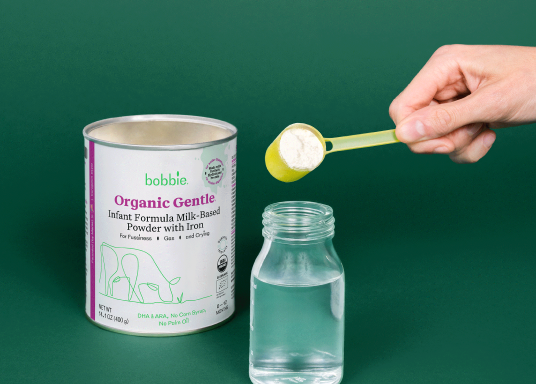
If parents do decide to try a different formula, it helps to make one change at a time so they can see whether the change actually improves symptoms. Bobbie Organic Gentle formula can be a great option as it contains partially-hydrolyzed whey protein, intended to help infants with gas and fussiness! Persistent symptoms such as blood in the stool, poor weight gain, or severe discomfort should always prompt a conversation with a pediatrician.
Meet the first and only USDA organic infant formula manufactured in the U.S.! Bobbie Organic Whole Milk Formula offers complete nutrition for baby's first year with our closest to breastmilk recipe.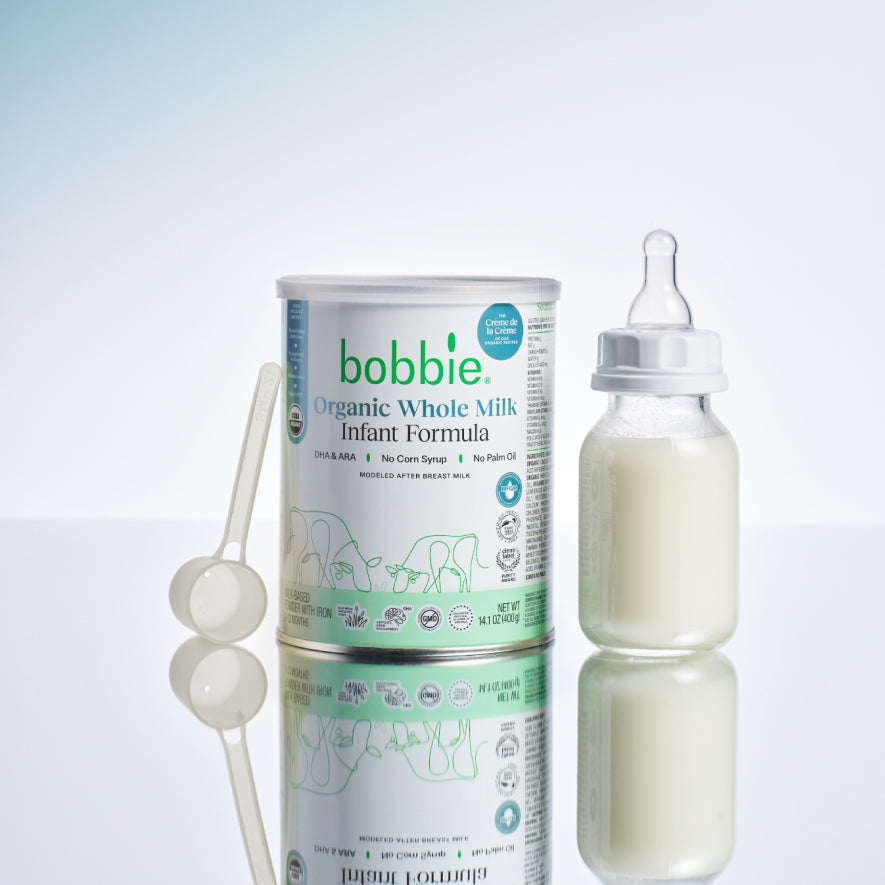
Shop Organic Whole Milk Infant Formula
Can I combine formula and breastmilk in the same bottle?
Yes, formula and breastmilk can be combined in the same bottle, and many families do this when combination feeding. In most cases, replacing breastmilk with formula ounce-for-ounce works well.
The important rule is that formula should always be prepared with water first according to the instructions. Once the formula has been properly mixed, breastmilk can then be added to the bottle. Breastmilk should never be used as the liquid to mix formula powder, because that would create a solution that is too concentrated for a baby’s kidneys.
Many families find that combination feeding works best when they remain flexible and follow the baby’s hunger cues rather than focusing strictly on exact ounce amounts.
How do I know if my baby is getting enough?
Parents often focus on ounces, but the better indicators of adequate feeding are diaper output and growth. Babies who are producing regular wet diapers and gaining weight steadily along their growth curve are typically getting enough nutrition.
General guidelines suggest that most babies eat anywhere between 10-20% of their body weight in ounces per day. This is a huge range, and depending on the size/age of the kid, could be between 20-35 ounces a day of breastmilk or formula. Some babies eat smaller amounts more frequently, while others take larger feeds.
If diaper output and weight gain are on track, parents can usually feel reassured that feeding is going well. Concerns about under- or over-feeding are always worth discussing with a pediatrician rather than immediately changing formulas.
Once a formula is working, should I keep looking for something better?
If a baby is growing well, comfortable, and feeding consistently, that formula is doing its job. Stability is important for infant digestion, and frequent switching can sometimes create more problems than it solves.
Digestive patterns take time to settle, and changing formulas repeatedly can make it difficult to know what is actually helping. For most families, the best time to research and compare formulas is when choosing the first one.
Once a baby is doing well on a formula, the goal is consistency and confidence in that choice. A formula that supports steady growth and keeps your baby comfortable is the right formula for your child.
The content on this site is for informational purposes only and not intended to be a substitute for professional medical advice, diagnosis or treatment. Discuss any health or feeding concerns with your infant’s pediatrician. Never disregard professional medical advice or delay it based on the content on this page.